4 Surprising Truths About Mass Timber That Could Change How We Build
Mass timber buildings are rising in cities around the world, celebrated for their warm aesthetics and their promise of a more sustainable future. The striking wooden structures often make headlines for their beauty and their potential to store carbon. But beyond the photogenic surfaces and eco-friendly talking points, a more complex and consequential reality is taking shape on balance sheets, in fire-testing labs, and on insurance underwriters' desks. Here, we explore four impactful takeaways that offer a deeper, more nuanced understanding of this material’s role in the future of construction tectonics.
--------------------------------------------------------------------------------
1. It Doesn’t Just Burn—It Fights Fire
The most immediate concern for a multi-story wooden building is, understandably, fire. Yet the reality of mass timber’s fire performance is profoundly counter-intuitive, representing a paradigm shift in fire safety philosophy—away from a focus on pure non-combustibility and toward one of predictable structural performance.
Unlike the light-frame lumber used in conventional wood construction, heavy mass timber elements perform with remarkable predictability. When exposed to extreme heat, the outer layer of a mass timber beam or panel burns at a slow, known rate. This process, called charring, creates a thick layer of carbon that acts as a highly effective insulator, protecting the structural core of the wood. This allows the element to maintain its load-bearing capacity for a significant and calculable period.
This performance stands in stark contrast to steel. While steel does not burn, it can become plastic and buckle after about an hour in a typical fire, leading to catastrophic failure. Mass timber, by charring, effectively sacrifices its outer layers to protect its inner strength.
The key to this reliable performance is bond line integrity, especially in products like Cross-Laminated Timber (CLT). The adhesives bonding the layers must hold up under heat to prevent delamination, which would expose fresh wood to the flames. CLT manufactured to U.S. standards, such as ANSI/APA PRG-320, is required to use adhesives that maintain their bond line integrity under fire, ensuring predictable charring without the delamination seen in some other products.
2. The Sticker Shock Isn't the Whole Story
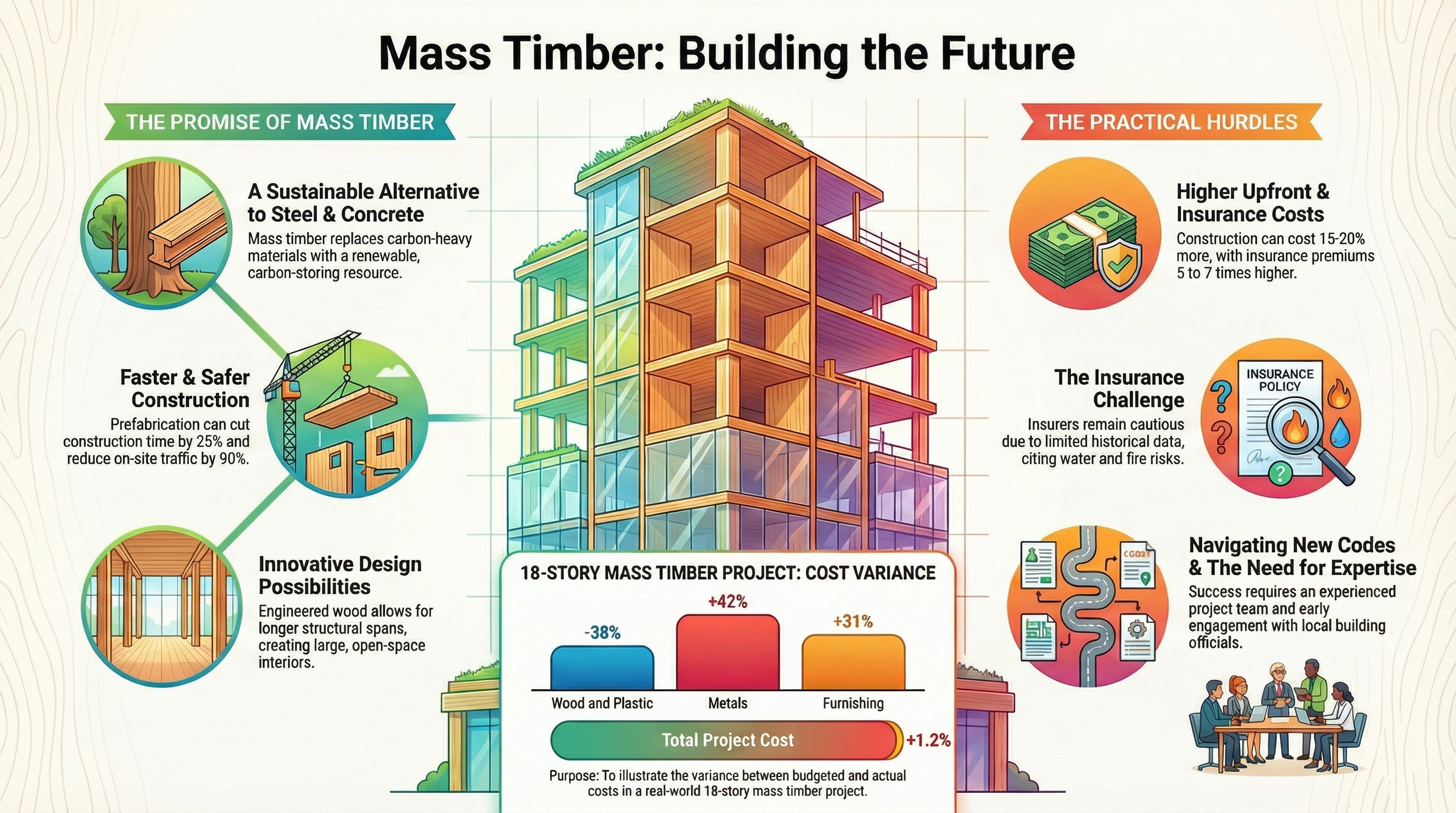
A common perception is that building with mass timber comes with a significant price premium. While the upfront material cost can be higher than that of light-frame wood, concrete, or steel, focusing solely on the raw material price misses the bigger picture of total project cost.
A detailed cost analysis of an 18-story mass timber project found the final construction cost landed only 1.2% over budget—a remarkably tight margin made even more impressive by the fact that it absorbed a five-month schedule delay caused by failures of conventional trades, namely elevators and storefronts. More tellingly, of the 205 change orders filed, only 12 were related to mass timber, accounting for a mere 4.38% of the total change order cost. This indicates that the new material typology itself was not a primary driver of cost overruns; in fact, it proved to be a predictable and stable component in a complex project.
Mass timber also generates significant savings in other project areas. The 340+ Dixwell affordable housing project in Connecticut provides a clear example:
• Finishes: By leaving timber ceilings and walls exposed, the project reduces the need for drywall and paint, saving on both materials and labor.
• Masonry: Elevator and stair shafts are constructed from CLT panels instead of more expensive and time-consuming concrete blocks.
• Schedule: Mass timber components are prefabricated off-site to precise specifications. This leads to dramatically faster on-site assembly, which reduces costs for labor, construction period interest on loans, and allows the building owner to begin collecting rent sooner.
These are not line-item trades; they are fundamental project savings in schedule, labor, and materials that ripple across the entire budget, directly offsetting the higher initial cost of the mass timber components. A true cost assessment, therefore, requires a holistic view of the project's financial and temporal ecosystem.
3. The Biggest Hurdle Isn't a Crane, It's an Insurance Policy
While engineers have largely solved the technical challenges of mass timber, one of the most significant obstacles today comes not from the construction site, but from the insurance industry. Securing adequate and affordable coverage has become a major hurdle for many mass timber projects.
The core of the issue is a lack of long-term historical claims data in North America. Without decades of data to build actuarial models, many insurers default to pricing mass timber for a "total loss scenario," incorrectly lumping it in with the fundamentally different fire performance of light-frame "stick-built" construction. This approach results in sticker shock for developers. This hesitancy persists even for well-planned projects, requiring developers to provide extensive documentation—including detailed fire protection plans and moisture management plans—just to secure coverage.
"At this time, the North American insurance market does not have a strong level of comfort with mass timber construction, as we also don’t have a long history with the material to learn from." — Susannah Davis, vice president, national construction and surety, Marsh
The situation, however, is beginning to change. As more successful mass timber projects are completed, a track record is being established and insurers are gathering more data. Consequently, costs are starting to normalize. Today, the cost to insure a mass timber project often settles "somewhere in the middle"—more than a non-combustible concrete or steel building, but significantly less than a combustible light wood-frame structure.
4. It's Not Just Sustainable, It's Radically Local and Circular
The sustainability of mass timber is often framed around its renewable nature and ability to sequester carbon. While true, this only scratches the surface of its potential. A deeper look reveals its capacity to foster a truly circular and hyper-local building philosophy, as demonstrated by the Brooklyn Mass Timber House.
This project repurposed its own history, starting with the original 1880s carriage house on the site. The team salvaged water and fire-damaged structural beams and, after clearing them of old iron nails, had them processed at a millwork shop just one mile away. The salvaged wood was dried, re-milled, and reinstalled as the new flooring, extending the life of the old-growth timber by another hundred years.
The commitment to a local supply chain was further tested during the pandemic. Faced with shortages from large window manufacturers, the team partnered with a local wood window fabricator just a few blocks away in the Navy Yard. This decision not only solved supply chain issues but also invested directly back into the local community.
Furthermore, the building embodies a "design for disassembly" ethos, turning the structure into a future materials bank. The entire mass timber staircase, held together with wooden dowels and concealed metal bolts, can be tightened, loosened, or completely dismantled for reuse, producing no waste. This approach manifests a core philosophy: to create new components that could themselves be recycled or reworked in 100 years without loss or degradation.
“The building exemplifies how modern methodologies can be used to re-purpose and enhance existing historic structures.” – Dezeen
Mass timber is more than just a beautiful, sustainable material; it is a complex technology that challenges long-held assumptions. It possesses an inherent fire resilience that signals a shift toward performance-based design. Its true cost can only be understood by looking beyond material price to savings in time and labor. While the insurance industry is still catching up, the path is normalizing. And most profoundly, mass timber offers a model for a construction future that is not only sustainable but also radically local, circular, and deeply connected to a material lifecycle.
As we face dual housing and climate crises, the question isn't just whether we can build with wood, but how thoughtfully we can integrate it into our communities, supply chains, and even our own history?
Contact Us for a Free Consultation

LOSAI STUDIO